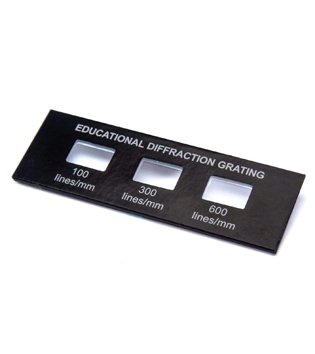
A Diffraction Grating is a precision optical component consisting of a large number of equidistant, parallel lines ruled onto a flat, transparent, or reflective surface. It is the fundamental component of all spectrometers and monochromators, replacing the prism for highly accurate wavelength analysis. When light passes through (transmission grating) or reflects off (reflection grating) the grating, it is diffracted into a pattern of spectral orders. This effect separates polychromatic light into its constituent wavelengths much more effectively and with higher resolution than a prism. The grating's ability to precisely separate light based on wavelength makes it an indispensable tool for measuring the wavelengths of light, analyzing atomic spectra, and performing complex optical measurements in physics and chemistry labs.
High Resolution Spectral Separation: Provides superior angular dispersion compared to prisms, enabling the high resolution separation and precise analysis of closely spaced spectral lines.
Wavelength Determination: The grating spacing (number of lines per unit length) is accurately known, allowing students to calculate the exact wavelength of light using the diffraction grating equation.
Multiple Orders: Produces multiple bright spectral images (diffraction orders) on either side of the central image, providing more data points for measurement and analysis.
Durable Construction: Typically protected by a glass or polymer substrate, offering durability and resistance to environmental factors when handled properly in the lab.
Versatile Use: Available in transmission type (used directly in the light path) and sometimes reflection type, suitable for different spectrometer and experimental setups.
Apparatus Type: Precision optical component for light dispersion and analysis.
Ruling Density: Varies by application, commonly available with 500 lines per mm or 1000 lines per mm (or more) spacing.
Substrate: High quality clear Glass or durable optical grade Polymer.
Application: Used for measuring wavelengths, calculating grating spacing, and analyzing spectral composition in optics and atomic physics experiments.
Size: Available in various sizes, typically small, square plates of $25 ext{ mm}$ to $50 ext{ mm}$ dimensions.