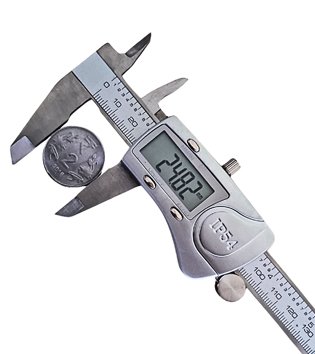
The Vernier Caliper is an essential precision measuring instrument used in physics, engineering, and manufacturing to measure linear dimensions with high accuracy. It operates on the principle of the Vernier scale, where a smaller, movable secondary scale slides alongside a main scale to increase reading precision far beyond a standard ruler. This tool is designed to accurately measure three things: outer diameter of objects, inner diameter of holes, and the depth of recesses. The two main types available are the Mechanical Vernier Caliper, which requires reading the coincident line on the Vernier scale, and the Dial Caliper, which displays the fractional reading directly on a circular dial for faster, less error-prone measurements.
High Precision Measurement: Provides readings with a high degree of precision, typically up to 002 mm or 001 inch, making it ideal for detailed laboratory experiments.
Multiple Measurement Modes: Features three sets of jaws and a depth rod to accurately measure external dimensions, internal dimensions, and the depth of holes or recesses.
Durable Construction: Built from hardened stainless steel or chrome plated metal for excellent durability, resistance to corrosion, and long term calibration stability.
Zero Adjustment: Includes a mechanism for zeroing the scale before use, ensuring the accuracy of all measurements by compensating for any minor wear or jaw misalignment.
Versatile Types: Available in traditional Mechanical Vernier models and Dial models offering faster, direct fractional readings via a clock face.
Measuring Range: Available in common ranges such as 0 to 150 mm (0 to 6 inches) or 0 to 300 mm (0 to 12 inches).
Accuracy Least Count: High precision, typically 002 mm (mechanical) or 001 mm (dial) reading capability.
Material: Hardened Stainless Steel or high quality tool steel.
Reading Format: Available with Metric (millimeter) and Imperial (inch) scales, or dual scale models.
Application: Used for length, external diameter, internal diameter, and depth measurements in physics and engineering labs.