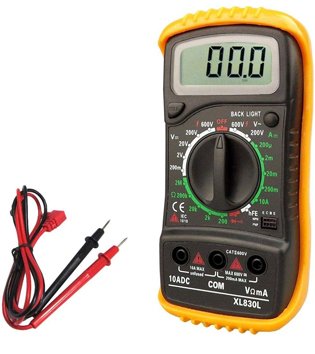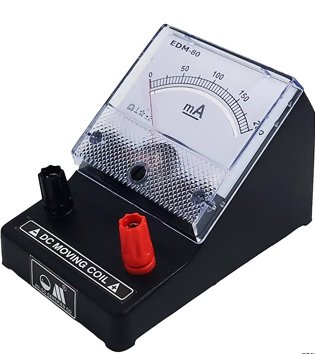
The Ammeter is a fundamental electrical measuring instrument used to determine the electric current flowing through a point in an electrical circuit. It measures current in units of Amperes (A). To correctly measure the current flowing through a component, an ammeter must always be connected in series with that component. It is designed to have very low internal resistance so that it does not significantly alter the current it is trying to measure. Laboratory ammeters are available in two primary forms: Analog Ammeters, which use a moving pointer over a calibrated scale, and Digital Ammeters, which display the current reading directly as a numerical value, offering higher precision and faster reading
Direct Current Measurement: Provides an accurate and direct reading of the magnitude of electric current (electron flow) in any part of a circuit.
Series Connection Design: Engineered with extremely low internal resistance to ensure that when connected in series, it minimally affects the total resistance and current flow of the circuit.
Versatile Types: Available in both Analog (pointer type) for basic demonstration and Digital (LCD display) for higher precision and ease of reading.
Wide Range Capability: Offered in various models to measure different current levels, ranging from microamperes (uA) and milliamperes (mA) for electronics to full Amperes for power circuits.
Robust Terminals: Equipped with clearly marked positive and negative terminals for safe and correct connection into the electrical circuit path.
Measurement Unit: Measures current in Amperes (A).
Internal Resistance: Typically very low, approaching zero ohms (ideally 0 ohm).
Measuring Range: Available in ranges such as 0 to 1 A, 0 to 5 A, or 0 to 500 mA DC or AC.
Display Type: Available as Analog (moving coil) or Digital (LCD display).
Connection: Must be connected in Series with the circuit component under test