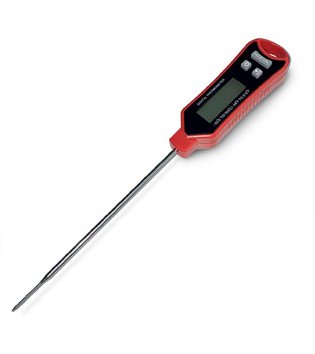
A Thermometer is a fundamental instrument used across all scientific disciplines to accurately measure temperature, which is a measure of the hotness or coldness of a substance. Laboratory thermometers typically rely on the principle of thermal expansion, using a liquid (such as colored alcohol or mercury) sealed within a glass tube. As the temperature rises, the liquid expands up a precisely calibrated scale. Modern laboratories also utilize Digital Thermometers which use electronic sensors (thermistors or thermocouples) to provide fast, highly precise numerical readouts. Thermometers are essential for conducting virtually every experiment in thermodynamics, chemistry, and biology, ensuring accurate data collection for processes like heating, cooling, phase changes, and reaction kinetics.
Accurate Temperature Reading: Provides a precise and reliable reading of temperature, essential for accurate data recording in scientific experiments.
Wide Measurement Range: Available in various forms to cover a broad spectrum of temperatures, from deep freezing points to high boiling points, suitable for all laboratory work.
Types Available: Offered in classic liquid in glass format (using alcohol or mercury) and modern digital formats (using electronic sensors) for specific accuracy and speed requirements.
Clear Calibration: Features a clear and durable scale marked in standard units, typically degrees Celsius (C), but also available in Fahrenheit (F) or Kelvin (K).
Chemical Resistance: Constructed with a durable glass casing for chemical resistance, allowing for immersion in most common laboratory liquids and solutions.
Measuring Unit: Measures temperature in degrees Celsius (C).
Operating Principle: Liquid in glass (thermal expansion) or Digital (electronic sensor).
Range: Varies by model, commonly 0 C to 100 C for general use, or wider ranges like -10 C to 150 C for specialized work.
Resolution: Typically marked with a resolution of 1.0 degree C or 0.1 degree C.
Application: Used for general temperature monitoring, measuring specific heat, determining boiling and freezing points, and monitoring reaction kinetics.