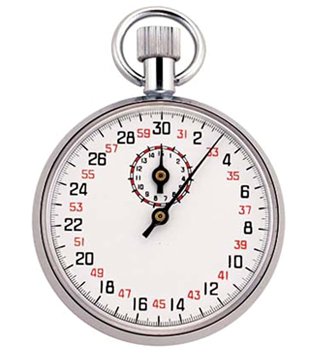
A Mechanical Stopwatch is a robust and traditional timing instrument used to measure the duration of an event with high precision. Unlike digital timers, it operates purely on mechanical principles, using a calibrated spring and gear train mechanism. It is typically activated and stopped by pressing a single crown or button, which also resets the hands to zero. This type of stopwatch is essential in many physics and sports laboratories for experiments involving time-dependent phenomena, such as measuring the period of a pendulum, the time of flight for projectiles, or the rate of a chemical reaction. It is valued for its audible clicking mechanism and its independence from battery power, providing a reliable, hands-on tool for teaching basic measurement and uncertainty in timing.
Reliable Mechanical Action: Operates using a sturdy spring and gear assembly, offering reliable timing independent of any electrical power source (batteries or mains).
Precise Time Measurement: Capable of measuring time with a high degree of precision, typically reading to 0.1 second or 0.2 second intervals on the analog dial.
One Button Operation: Simple and intuitive operation, often using a single crown or plunger to start, stop, and reset the mechanism, minimizing confusion during experiments.
Analog Display: Features a clear analog dial with two hands (one for seconds, one for minutes) for easy, visual reading of the elapsed time.
Durable Casing: Housed in a robust metal or durable plastic casing to withstand the repeated use and handling common in busy educational laboratories.
Apparatus Type: Spring-driven, non-electronic timing instrument.
Display: Analog dial with primary (seconds) and secondary (minutes) hands.
Accuracy (Least Count): Typically 0.1 s (one tenth of a second) or 0.2 s per division.
Timing Range: Usually capable of measuring events up to 30 minutes or 60 minutes duration.
Application: Used for measuring time periods of oscillations, motion experiments, and reaction timing in educational physics and chemistry.