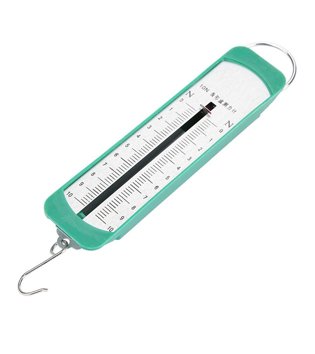
The Newton Force Meter, commonly known as a Spring Scale or Dynamometer, is a fundamental instrument used in physics laboratories to measure force or weight. It operates based on Hookes Law, which states that the force applied to a spring is directly proportional to the distance it is stretched or compressed. The meter consists of a calibrated spring enclosed in a casing with a scale marked in Newtons (N), the standard unit of force, and often simultaneously in grams (g) for mass measurement. By hanging an object from the hook or pushing against the sensor, the meter provides a direct, visible reading of the applied force. It is an indispensable tool for experiments involving gravity, friction, tension, and the vector nature of forces.
Direct Force Measurement: Provides a fast, direct, and accurate measurement of force in the metric unit of Newtons, crucial for mechanics experiments.
Hookes Law Demonstration: Visually demonstrates the principle of elasticity and Hookes Law, showing the linear relationship between applied force and spring extension.
Dual Scale Reading: Typically features a dual scale calibrated in both Newtons (N) for force and grams or kilograms (g/kg) for mass or weight measurement.
Zero Adjustment: Includes a simple mechanism at the top for zeroing the meter before use, ensuring accurate readings by compensating for the weight of the hook or any minor spring fatigue.
Durable Construction: Built with a robust metal spring and a clear plastic or metal casing to withstand repeated stretching and provide a long operational lifespan in student labs.
Measuring Unit: Calibrated to measure force in Newtons (N).
Operating Principle: Based on the principle of Hookes Law and spring extension.
Measuring Range: Available in various ranges, commonly 0 to 1 N, 0 to 5 N, 0 to 10 N, up to 0 to 50 N or more.
Construction: Metal spring housed in a plastic or metal body with top ring and bottom hook.
Application: Used for measuring tension, friction, weight, and resolving forces into vectors