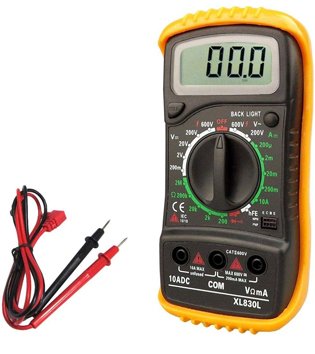
A Digital Voltmeter (DVM) is an essential electronic instrument used in the laboratory to precisely measure the electric potential difference (voltage) between two points in a circuit.
High Digital Accuracy: Provides superior accuracy and resolution, often reading to several decimal places, clearly displayed on a large LCD screen to minimize reading errors.
High Internal Resistance: Engineered with extremely high internal resistance to ensure that when connected in parallel, it draws negligible current and does not affect the voltage measurement.
Versatile AC DC Modes: Capable of measuring both Direct Current (DC) voltage (from batteries or power supplies) and Alternating Current (AC) voltage (from mains or generators).
Auto Ranging Functionality: Many models feature automatic ranging, which intelligently selects the correct measurement scale, simplifying use and protecting the device from overload.
Data Functions: Often includes features such as data hold to freeze the last reading, and min max recording to capture transient voltage changes.
Measurement Unit: Measures potential difference in Volts (V).
Internal Resistance: Typically very high, approaching millions of ohms (ideally infinite ohms).
Measuring Range: Varies by model, commonly 0 to 20V DC and 0 to 750V AC.
Display Type: Digital LCD screen with multi digit display.
Connection: Must be connected in Parallel across the component being tested.